
Quick Links:
Which Bottle?
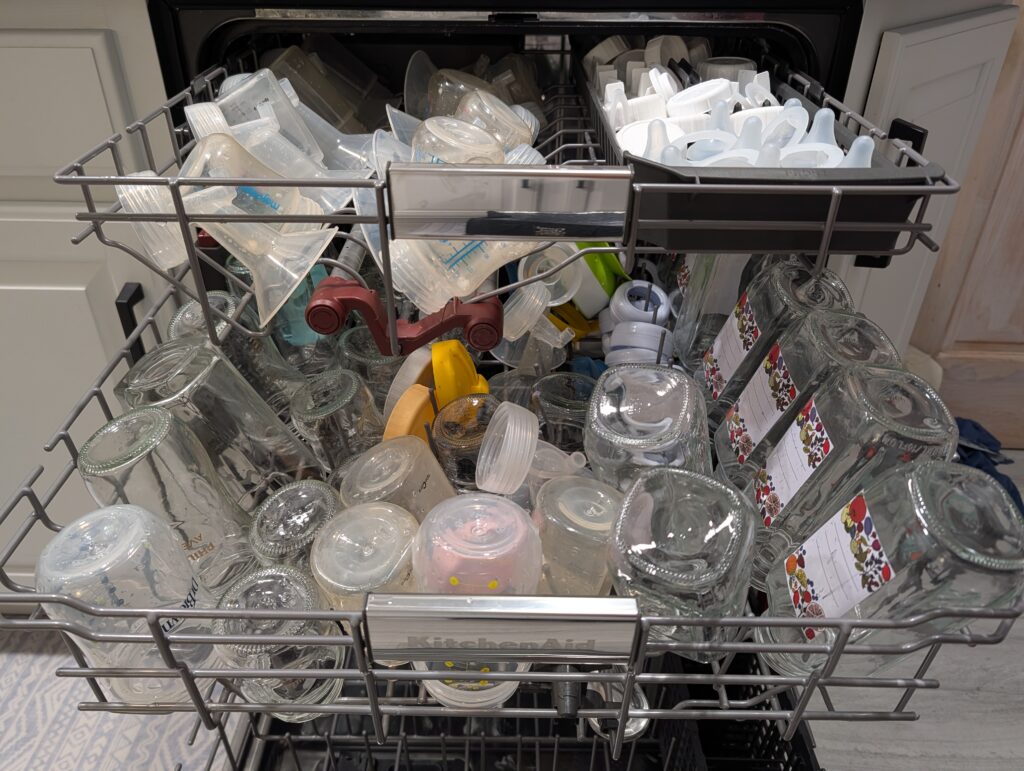
If you’re pumping for feedings or doing formula, prepare to use a lot of bottles in a day. When you’re considering bottles, the first thing to consider is how you’ll be washing them. Having a dishwasher is a game changer… You can even sterilize them in there if your dishwasher comes with a sterilize setting. In that case, you can save your time, money, and counter space from a bottle sterilizer machine.
Even if you have a dishwasher, you’ll still want some scrub brushes and a drying rack from when you inevitably run low on supplies and need to quickly hand wash some pieces, or for when the dishwasher doesn’t completely dry nipples and pump parts.
There are many options out there for bottles but when I was pregnant, I saw the most recommendations for Dr. Brown’s and Philips Avent.
The Dr. Brown’s bottle functionality is good, but there are many pieces to clean, so keep that in mind if you are hand washing bottles.
When I was pregnant, I made the mistake of looking too far into microplastics. Don’t do it. Your babies will be unavoidably surrounded by microplastics their entire life so choosing to use plastic bottles is not going to make a difference in the grand scheme of things. Still, my pregnant brain couldn’t get passed it. After pretty much psyching myself out and doing far too much research, I concluded that the largest concern was when the plastic was actively heated, so sanitizing plastic wouldn’t be a problem since the bottle would cool before touching the milk. However, I was still concerned about leaching when I wanted to warm bottles before feedings so that resulted in us selecting glass bottles.
We chose the glass Philips Avent bottles. There are both 4 oz and 8 oz bottles. We used primarily the 4 oz bottles for the first 6 months and after that moved to the 8 oz bottles. You can skip the 4 oz bottles all together, but in the beginning, the 8 oz bottles are too heavy for their little hands. They self-fed easier with tinier bottles.
Which Nipple?
If you’re doing a combination of nursing and bottle feeding, two things are important to look into to prevent a bottle preference: pace feeding and the Triangle Test. Lactation consultants recommend choosing bottle nipples that pass the Triangle Test as nipples that pass this test promote a strong, deep latch that more closely compare to being on the breast. Second, you will want the absolute slowest speed nipples to prevent them from getting milk from the bottle faster than breastfeeding.
Though I love the Avent glass bottles themselves, even their natural flow nipples do not pass the test, and we also had issues with them leaking. There’s an air hole that needs line up with the collar which is hard to see in the dark, and if they were not perfectly aligned, our babies struggled to eat from them. This resulted in us testing several other nipples.
After trying many different nipples that pass the Triangle Test, our favorites were Lansinoh XS and Pigeon SS. While it didn’t leak, the Lansinoh had too strong of a flow for one of my twins so we stuck with the super slow flow Pigeon nipples.
Note: These nipples have a bit smaller diameter than the ones that come with the Avent bottles so you need a converter such as the MayMom rings and caps to be able to use them.
If you do go with glass bottles, they can be heavy and slippery, so silicone covers can help the babies get a nice grip when they’re ready for self-feeding and they provide a little bit of fall protection too. We have yet to break one of the glass bottles despite several nice falls.
Though a bit complicated, I absolutely love this combination. Regardless of how old the twins got, they stayed on the slowest flow nipple to continue to prevent them from gulping. I hear some people have breast milk that gets fattier and therefore needs a faster nipple to fit through but that wasn’t the case with me. So, save some money by not buying faster flow nipples ahead of time that you may not need.
I’d recommend a minimum of 16 bottles, nipples and collars if you’ll be doing the dishes daily.
Feeding Stations
You’ll need a feeding station so you can feed both babies at once. The Twin Z is a great option as it’s a multipurpose breastfeeding pillow that you can also prop your babies in for feeding them bottles. However, if you won’t be combo breastfeeding, consider the Table for Two as it’s at the ideal angle for safe feeding and comes with straps. It is larger, more rigid and less ideal for travel, but it all comes down to how you’re going to use it.
TLDR (Summary)
If you aren’t set on glass bottles, I’d honestly just recommend going right to best nipples from the start. Skip the Avent bottles, and get the Pigeon bottles in both small and large with the SS nipples.
If you want to prioritize glass bottles, the combo of Avent bottles, Pigeon SS, and MayMom rings with optional silicone covers will do the trick!