The equipment you select can make or break your experience. I made a poor decision with my first pump and that added time and stress.
Before you make any decisions on pumps, check your insurance! Many insurances will reimburse a pump purchase so you’d want to select one that is covered. Be aware that the wording can be sneaky. My insurance said they’d cover “one pump per birth” so we hoped we’d get two pumps for birthing two babies. However, they only covered one pump as they considered twin birth as one event. So do your research here first and ask your insurance any questions you have in advance.
There are three main categories of pumps you may consider getting. Automatic, manual, and wearable. Either way, make sure any pumps you get are hospital grade because you want strong, efficient pumps with the amount you’ll be pumping.
Manual pumps are effective but require your hand and you can only do one side at a time unless you buy a second manual pump. If you’re pumping for two this can take more time than you have to spare. My hospital gave me a Medela manual and I do use it on occasion. I mostly use it when I need to take the edge off until I can do a full session on an automatic pump.
Wearable is convenient for when you’re pumping on the go or if you’re shy about pumping in front of certain people. However, this may not be suitable as your main pump if you’ll be exclusively pumping for twins. Many wearables have a smaller limit on how much milk it can hold and if you’re making enough for two, you’ll likely need more storage capacity.
If you get a wearable, I would not recommend the Elvie Stride. I liked it at first but it ended up leaking and they didn’t have replacement parts for sale so I had to wash my one set constantly.
I’d instead recommend the Momcozy or Medela Hands-Free for your on-the-go pumps.
For your main pump, you’ll want an automatic and the most serious, best rated options are from Spectra and Medela Hospital Grade. As a twin mom, the make-or-break here is that the blue Spectra S1 is portable meaning you won’t be wired to a wall. Trust me, when you get to the point you’re chasing two mobile babies with no balance simultaneously, you’ll need to have the freedom to move around the room.
You’ll want to stock up on multiple pump flange sets including the bottles, flanges, and duck bills. I’d recommend having enough complete sets for the number of times you’ll be pumping each day to prevent needing to clean your setup between each pump. You can get by without doing this, but time will be scarce in the newborn phase and this can save valuable time. In the beginning as an exclusive pumper, you’ll be pumping every 3 hours. so you’ll want 8 sets.
The spectra sets are expensive so I’d recommend getting the MayMom flanges, bottles, and duck bills. I change my backflow on each side once a day so you can get by with only 4 of these. Also, consider getting some taller bottles, as well, if you produce a lot of milk.
Regardless of the pump you pick, be sure to measure your nipple and get appropriately sized flanges for comfort and maximizing output. Most pumps come with a way to measure this.
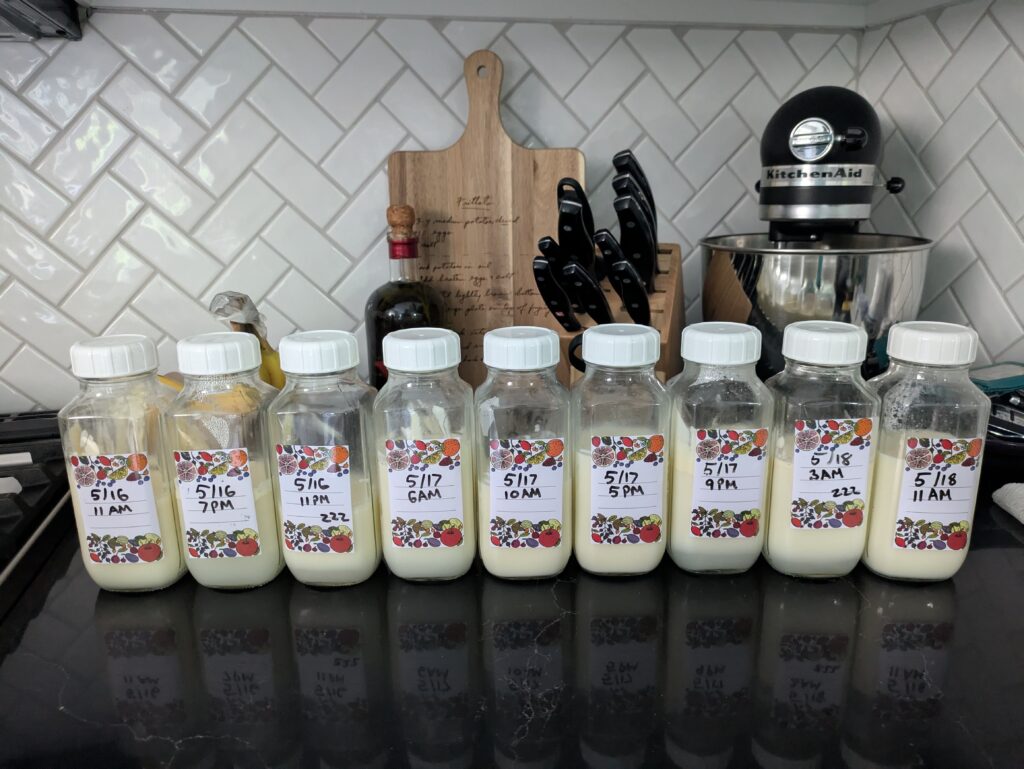
You’re also going to need bottles to store the pumped milk. We chose these 16 oz glass bottles with dry erasable fronts so we could label what day and time each pump was. However, they are not the same strength glass as the Avent bottles, so we have broken one of them. The labels also get somewhat deteriorated by the dishwasher after many uses, but they still serve their purpose. If you want something stronger, also made from borosilicate glass like the Avent bottles, try these more durable glass bottles. They’re more expensive, though.